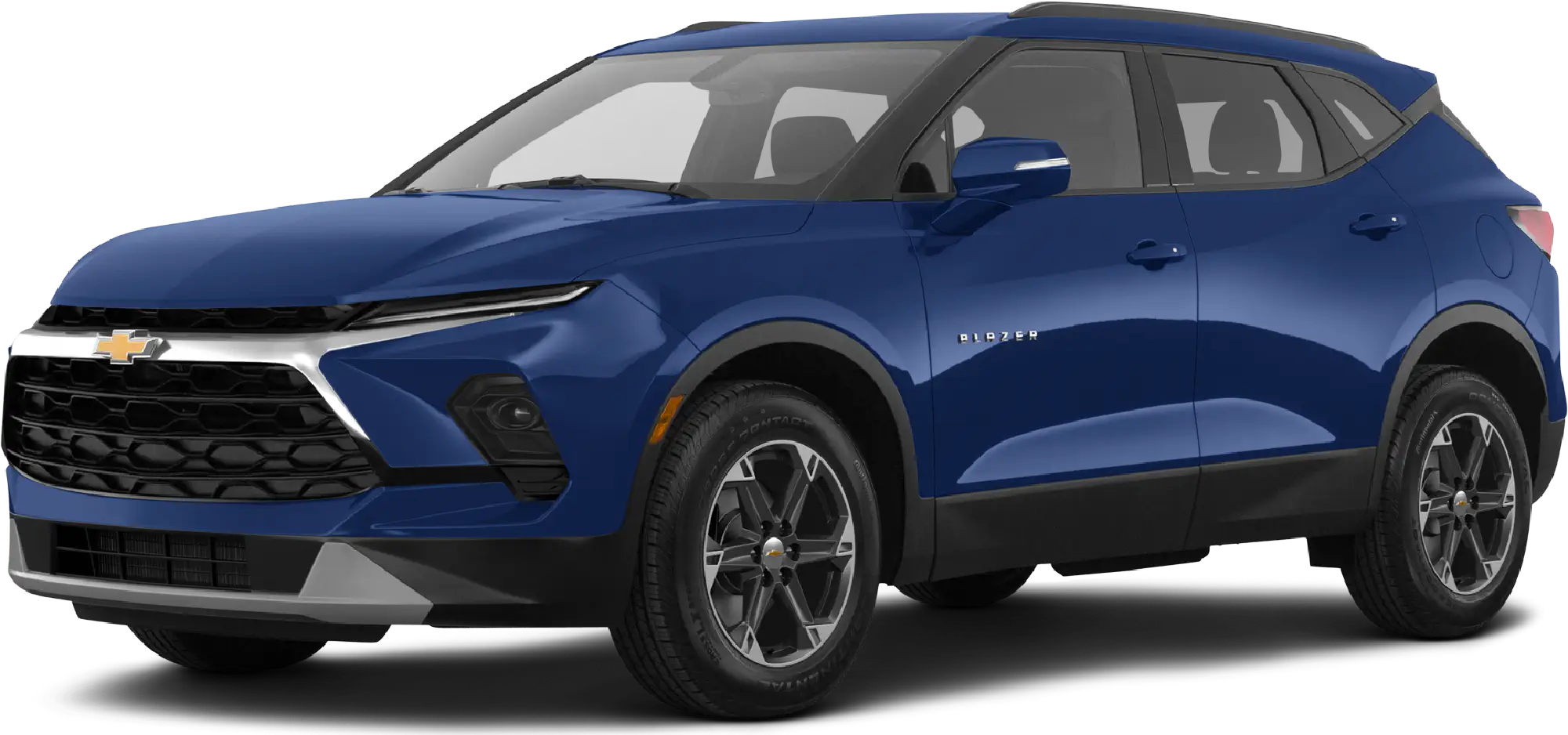
Best Chevrolet Blazer Trim for Style and Performance
Shopping the Chevy Blazer trim levels comes down to deciding how much you value appearance, performance, comfort, and long-term ownership costs.
Chevrolet’s midsize two-row SUV already leans heavily into sporty styling, but moving from the 2LT to the 3LT and RS can noticeably change both the look and the driving experience.
For 2026, Chevrolet lists three gasoline Blazer trims: 2LT, 3LT, and RS. The 2.0-liter turbocharged four-cylinder is standard across the lineup, while the RS can be equipped with a 3.6-liter V6 producing 308 horsepower and 270 lb-ft of torque.
For buyers prioritizing both style and performance, the Blazer RS is the standout. Buyers who care more about value, efficiency, or everyday equipment may find that one of the LT trims makes considerably more financial sense.
Chevrolet designed the Blazer as one of the more visually assertive SUVs in its class. Its low roofline, prominent grille, narrow lighting elements, and relatively wide stance give it a sportier character than many conventional family-oriented crossovers.
That personality becomes progressively stronger as you climb the Chevy Blazer trim levels.
Here is a simplified look at the 2026 gasoline lineup based on Chevrolet’s published specifications and starting prices. Prices can change and exclude certain taxes, fees, options, and other charges, so shoppers should confirm current pricing before purchasing.
| Trim | Starting MSRP* | Standard Engine | Horsepower | Best For |
|---|---|---|---|---|
| 2LT | $34,300 | 2.0L turbo four-cylinder | 228 hp | Value and everyday driving |
| 3LT | $39,700 | 2.0L turbo four-cylinder | 228 hp | Added convenience and upscale equipment |
| RS | $43,600 | 2.0L turbo four-cylinder | 228 hp | Sporty appearance and available V6 performance |
The RS deserves an important clarification. The 2.0-liter turbo is standard for 2026, while the 308-horsepower 3.6-liter V6 is available. Buyers specifically shopping for the most powerful Blazer should therefore verify that the RS they are considering actually has the V6.
Engine choice creates the biggest performance difference in the lineup. Chevrolet’s 2.0-liter turbo produces 228 horsepower and 258 lb-ft of torque, which is sufficient for commuting, highway driving, and routine family use.
The available 3.6-liter V6 changes the Blazer’s character. Output increases to 308 horsepower and 270 lb-ft of torque, giving drivers substantially more horsepower for highway merging, passing, and acceleration. Both engines are paired with a nine-speed automatic transmission.
Fuel economy creates a tradeoff. Chevrolet lists the turbo four-cylinder at up to an EPA-estimated 29 mpg highway with front-wheel drive, while the available V6 is rated at up to 26 mpg highway with front-wheel drive.
The RS also has access to an Advanced Twin-Clutch all-wheel-drive system, which is standard when the RS is configured with AWD. That configuration makes the RS particularly appealing to drivers who want the Blazer’s strongest combination of traction, styling, and performance.
Blazer 2LT provides much of the vehicle’s visual appeal without requiring buyers to jump directly into the $40,000-plus portion of the lineup. It comes standard with the 2.0-liter turbo engine, Chevy Safety Assist, Driver Confidence Package, 64.2 cubic feet of maximum cargo space, and a 10.2-inch touchscreen.
Available Midnight and Sport Editions give 2LT buyers another way to emphasize appearance without moving all the way to an RS. That makes the 2LT especially interesting for shoppers who want the Blazer’s aggressive design but do not necessarily need maximum performance.
From a long-term ownership standpoint, choosing the lower trim can also mean fewer expensive optional features to repair later. A simpler configuration does not guarantee lower repair bills, but it can reduce the number of premium systems and accessories that may eventually require attention.
Moving into the 3LT brings the Blazer closer to an upscale daily driver. Chevrolet includes a programmable power liftgate and roof rails, while options include a sunroof and Sound and Technology Package.
That makes the 3LT a sensible choice for someone who likes the Blazer’s appearance but prioritizes convenience over outright performance.
There is one significant distinction for 2026 shoppers. Unlike the 2025 model, when Chevrolet offered the 3.6-liter V6 on the 3LT, Chevrolet’s current 2026 specifications list the V6 only as available on the RS.
Used-vehicle shoppers should pay close attention to this model-year difference. A used 3LT may have a different powertrain configuration than a new 2026 3LT.
For the specific buyer searching for the best Chevrolet Blazer trim for style and performance, RS is the clear choice.
Visual changes include RS-specific badging, black Chevrolet bowties, a black grille, 20-inch wheels, and rectangular bright exhaust tips. Chevrolet also offers 21-inch wheels, helping the RS create a more performance-oriented appearance than the LT trims.
More importantly, RS is the only 2026 gasoline Blazer trim offering the 3.6-liter V6. Selecting that engine raises output from 228 to 308 horsepower, a difference of 80 horsepower.
An RS with the V6 and Advanced Twin-Clutch AWD is therefore the configuration to target when performance is the priority. Drivers who mainly want the RS appearance can retain the standard turbo four-cylinder.
Higher trim levels do not automatically mean dramatically higher repair bills, since the Blazer trims share many underlying components. The potential cost difference becomes more relevant when optional powertrain, AWD, electronic, wheel, convenience, and driver-assistance equipment is added.
Routine diagnostic appointments can range from roughly $100 to several hundred dollars depending on the problem, labor rates, and how much troubleshooting is required. Actual repairs can range from relatively inexpensive sensors or switches to four-figure mechanical or electronic work.
An AWD system, for example, introduces components that a front-wheel-drive vehicle does not require. Large wheels and lower-profile tires can also cost more to replace than simpler wheel-and-tire packages.
The same principle applies to power liftgates, infotainment equipment, cameras, driver-assistance technology, and other convenience features. None of this means buyers should avoid a better-equipped Blazer. It simply makes long-term repair exposure worth considering when comparing trims.
| Ownership Item | What Can Affect Cost |
|---|---|
| Engine | Turbo four-cylinder versus available V6 |
| Drivetrain | FWD versus AWD |
| Wheels and Tires | Larger RS wheel options may increase tire expense |
| Driver Assistance | Sensors, cameras, modules, and calibration requirements |
| Convenience Features | Power liftgate, infotainment, and other electronics |
| Diagnosis | Labor rate and complexity of the reported problem |
These are ownership considerations rather than guaranteed repair expenses. A qualified Chevrolet service department or repair facility should diagnose a specific problem before an owner authorizes repairs.
Trim selection matters less to reliability than maintenance habits. Following Chevrolet’s maintenance recommendations, checking fluid levels, maintaining correct tire pressure, and addressing warning lights promptly can help prevent smaller problems from becoming more expensive ones.
Chevrolet provides an official vehicle maintenance schedule and recommends consulting the Owner’s Manual for model-specific service information.
Owners of AWD models should pay particular attention to drivetrain-related maintenance recommendations. Tire condition also matters because substantial differences in tire size, tread depth, or inflation can affect how an AWD vehicle behaves.
RS owners with larger wheels should inspect tires regularly for damage and uneven wear. Performance-oriented styling looks good, but replacement tires and wheels can represent a meaningful ownership expense.
Technical Service Bulletins, commonly called TSBs, are manufacturer communications that provide technicians with information about known symptoms, diagnostic procedures, updated parts, or repair processes. A TSB is not automatically the same thing as a safety recall, and its existence does not necessarily mean a repair will be performed free of charge. Owners can search for manufacturer communications and TSB information through the NHTSA recall and vehicle lookup resources; NHTSA explains that manufacturer communications can be found within vehicle search results.
There is no reason to avoid a particular Blazer trim simply because it contains more equipment. Buyers should instead understand that adding mechanical and electronic complexity can increase potential repair exposure as a vehicle ages.
A 2LT with front-wheel drive represents the comparatively straightforward route. An RS equipped with the V6, AWD, larger wheels, and additional technology provides considerably more of the performance-oriented experience many Blazer shoppers want, but it also places more expensive hardware in the ownership equation.
How long you plan to keep the vehicle matters. Someone leasing for a few years may evaluate the trim decision differently from a buyer planning to own a Blazer well beyond its original warranty period.
Before buying used, obtain a pre-purchase inspection, review the maintenance history, check the VIN for open recalls, and test every electronic feature. Pay particular attention to unusual transmission behavior, warning lights, AWD messages, infotainment problems, and abnormal noises.
Drivers keeping a Blazer beyond its original warranty period may want to consider how an unexpected covered repair would fit into their budget.
An extended vehicle service plan can shift certain eligible repair expenses away from a large, unexpected out-of-pocket bill. Coverage varies by contract, so owners should always review covered components, exclusions, deductibles, eligibility requirements, and contract terms before purchasing.
Granger Warranty offers extended coverage options with transparent pricing and an online purchasing process. Buyers can compare available protection based on their vehicle and anticipated ownership period without making warranty coverage the deciding factor in which Blazer trim they choose.
That can be particularly relevant for drivers choosing an option-heavy Blazer and planning to keep it for many years. Coverage should complement good maintenance rather than replace it.
The 2026 Blazer RS is the strongest choice because it is the only gasoline Blazer trim offering the 3.6-liter V6. That engine produces 308 horsepower and 270 lb-ft of torque, compared with 228 horsepower from the standard 2.0-liter turbo.
RS has the most performance-focused factory appearance. RS-specific badging, black exterior accents, 20-inch wheels, available 21-inch wheels, and distinctive exhaust tips visually separate it from the LT models.
It can be for buyers who value added convenience. The 3LT includes equipment such as a programmable power liftgate and roof rails while opening access to additional options including a sunroof and Sound and Technology Package.
No. Chevrolet lists the 2.0-liter turbo four-cylinder as standard on all 2026 gasoline Blazer models, including RS. The 3.6-liter V6 is available on RS, so shoppers seeking 308 horsepower need to verify the vehicle’s actual engine.
For many drivers, the 2LT offers the strongest value because it combines the Blazer’s core styling with a 228-horsepower turbo engine, 10.2-inch touchscreen, standard safety technology, and available appearance packages. Buyers who define value primarily through performance should instead consider the RS with the available V6.
Choosing among the Chevy Blazer trim levels ultimately depends on what you want from the SUV. The 2LT makes a strong case for budget-conscious shoppers, the 3LT adds convenience and refinement, and the RS is the natural pick for drivers prioritizing sporty styling and available V6 performance.
Long-term ownership deserves consideration alongside horsepower and appearance. Modern powertrains, AWD hardware, infotainment systems, and driver-assistance equipment can become costly when repairs occur outside the original warranty period.
If you plan to keep your Chevrolet for years to come, visit Granger Warranty to explore available extended coverage options, compare pricing, and decide whether additional protection makes sense for your ownership plans.
Stay up to date with the latest news from Granger Warranty