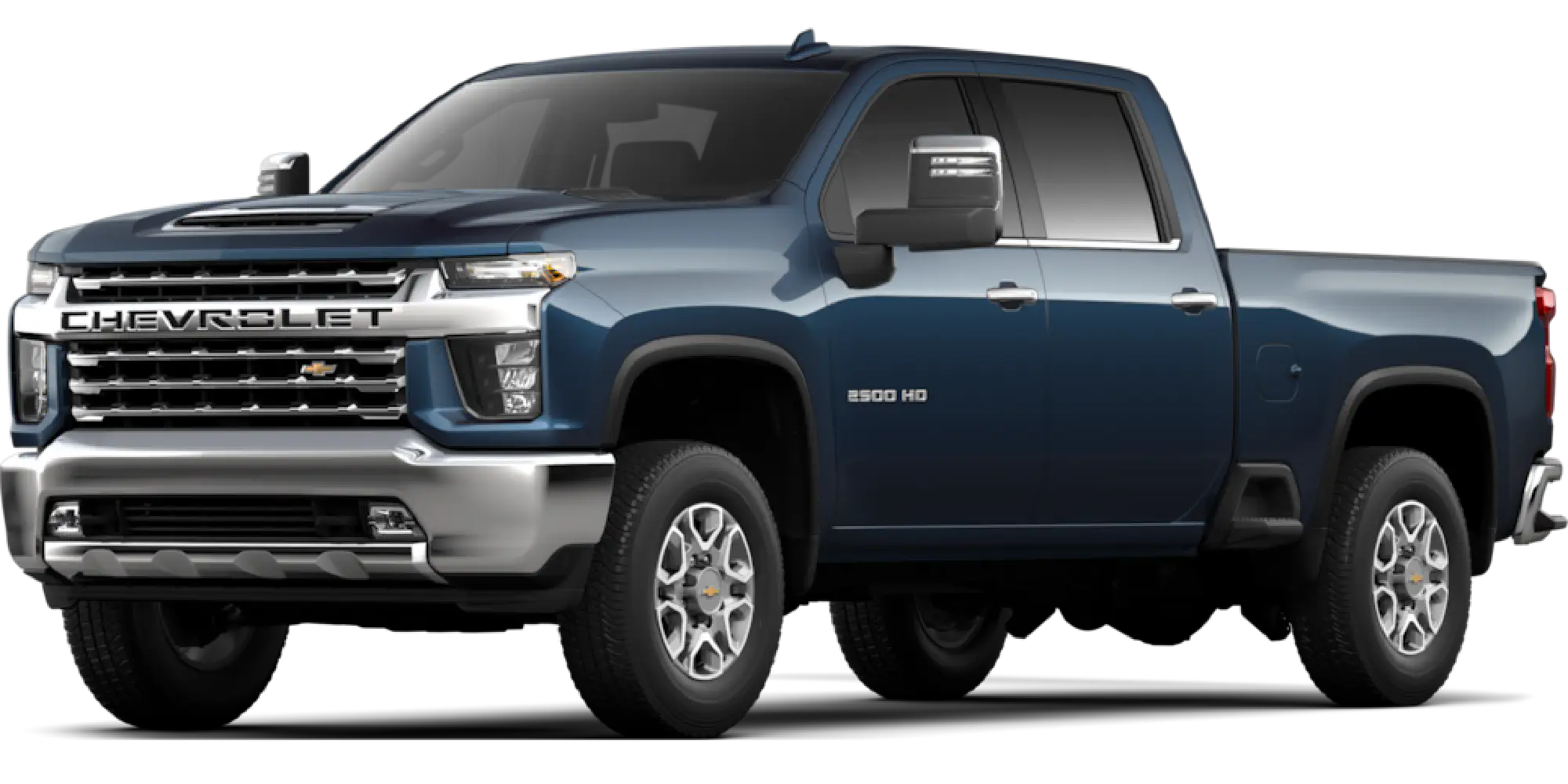
Best Chevrolet Silverado HD for Heavy Towing: 2500 vs 3500
Choosing between Chevrolet’s heavy-duty pickups becomes much more important once trailers get genuinely heavy. For RV owners, equipment haulers, contractors, and agricultural users, the Silverado 2500 vs 3500 towing decision affects more than the maximum number printed in a brochure.
Both Silverado HD models offer serious capability, including Chevrolet’s available 6.6-liter Duramax turbo-diesel V8 and 10-speed Allison automatic transmission. The biggest differences involve maximum towing capacity, payload, rear-axle configuration, stability, and how much reserve capability you want when the truck is loaded with passengers, cargo, and trailer pin or tongue weight.
For many recreational buyers, the Silverado 2500 HD provides plenty of truck without the additional capability of a 3500 HD. Drivers routinely pulling large fifth-wheel campers, commercial trailers, or equipment near 20,000 pounds and beyond should take a much closer look at the 3500 HD.
Current Chevrolet specifications make the basic hierarchy clear. For the 2026 model year, Chevrolet lists maximum trailering capability of 22,420 pounds for the Silverado 2500 HD and 36,000 pounds for the Silverado 3500 HD, when each truck is properly configured.
Those headline numbers should not be interpreted as the towing rating of every Silverado HD on a dealer lot. Cab style, drivetrain, engine, bed length, axle configuration, equipment, passengers, accessories, and cargo can all affect the rating of an individual truck.
| Silverado HD Specification | Silverado 2500 HD | Silverado 3500 HD |
|---|---|---|
| Maximum Available Towing | 22,420 lbs. | 36,000 lbs. |
| Available Diesel Engine | 6.6L Duramax V8 | 6.6L Duramax V8 |
| Diesel Output | 470 hp | 470 hp |
| Diesel Torque | 975 lb-ft | 975 lb-ft |
| Available Dual Rear Wheels | No | Yes |
| Best Fit | Moderate to heavy recreational towing | Maximum-capacity recreational and commercial towing |
Chevrolet’s current Duramax produces 470 horsepower and 975 lb-ft of torque, while the standard 6.6-liter gasoline V8 produces 401 horsepower and 464 lb-ft. Both engines are paired with a 10-speed Allison automatic transmission.
Maximum towing capacity gets most of the attention, but payload can become the limiting factor first.
A fifth-wheel trailer places a significant percentage of its loaded weight directly over the truck’s rear axle. Add passengers, tools, a toolbox, auxiliary fuel, hitch hardware, and other cargo, and a truck can reach its payload or axle limits before reaching its advertised maximum towing capacity.
That distinction is especially important for large fifth-wheel RVs.
A Silverado 2500 HD might have enough rated towing capacity for a particular fifth-wheel based solely on trailer weight. Its available payload still needs to accommodate the trailer’s actual loaded pin weight plus everything else carried by the truck.
A properly configured 3500 HD provides additional capacity for buyers who routinely operate in this range. Chevrolet lists maximum available Silverado HD payload at up to 7,237 pounds across the HD lineup, depending on configuration.
Always verify the specific truck’s certification labels and Chevrolet trailering information rather than relying solely on model-wide maximums.
Bigger is not automatically better.
A Silverado 2500 HD can be the more practical choice for owners towing travel trailers, moderate-size fifth-wheels, enclosed car trailers, boats, and equipment trailers that comfortably fit within the truck’s ratings.
Chevrolet’s current trailering charts show properly equipped 2500 HD configurations reaching beyond 22,000 pounds of fifth-wheel or gooseneck capability. Exact ratings vary considerably depending on cab, drivetrain, bed, wheel, engine, and equipment configuration.
The 2500 HD can also make more sense when the truck spends significant time without a trailer. Buyers get substantial heavy-duty capability without stepping into a dual-rear-wheel configuration.
For someone towing a 12,000- to 16,000-pound recreational trailer several weekends each year, for example, a correctly configured 2500 HD may provide ample capacity. Actual trailer tongue or pin weight still needs to be checked carefully.
Large fifth-wheels, horse trailers, construction equipment, and commercial loads can quickly make the Silverado 3500 HD’s additional capacity worthwhile.
Chevrolet rates the 3500 HD for as much as 36,000 pounds of gooseneck towing in its highest-capacity configuration. Reaching that number requires a specific setup, including the Duramax diesel, dual rear wheels, and appropriate trailering equipment.
Dual rear wheels are particularly valuable when substantial pin or tongue weight is involved. Four rear tires increase rear-end load capacity and can provide additional stability when controlling a large trailer.
The downside is obvious during everyday use. A dually is wider, takes more room in parking lots, requires two additional rear tires, and may be more truck than recreational owners need.
For regular towing approaching the upper end of a 2500 HD’s ratings, moving to the 3500 HD can provide valuable capacity rather than operating close to the truck’s limits on every trip.
Chevrolet offers both HD pickups with a 6.6-liter gasoline V8 or available 6.6-liter Duramax turbo-diesel V8.
The gasoline engine’s 401 horsepower and 464 lb-ft of torque are sufficient for many moderate towing jobs. Chevrolet lists maximum available gas-engine trailering at 19,080 pounds across the Silverado HD range.
The Duramax changes the equation considerably.
Its 470 horsepower is useful, but the more meaningful towing figure is 975 lb-ft of torque. That low-speed pulling power helps when accelerating a heavy combination, climbing grades, or maintaining speed under load.
Diesel ownership brings additional complexity and maintenance considerations, including emissions equipment and diesel-specific components. Buyers who tow frequently and heavily are more likely to benefit from the Duramax, while occasional moderate towing can make the gasoline V8 an attractive alternative.
Heavy towing places additional thermal and mechanical stress on a truck, particularly when the vehicle spends significant time near its maximum ratings.
Repair costs vary dramatically by model year, powertrain, diagnosis, labor rate, and whether the problem involves routine wear or a covered mechanical failure. The ranges below are general budgeting estimates rather than quotes.
| Potential Service or Repair | Approximate Cost Range |
|---|---|
| Heavy-Duty Brake Service | $500-$1,500+ |
| Wheel Bearing or Hub Repair | $500-$1,000+ per corner |
| Cooling-System Repair | $500-$2,000+ |
| Diesel Emissions Component Repair | $500-$3,000+ |
| Turbocharger-Related Repair | $2,000-$5,000+ |
| Major Transmission Repair or Replacement | $4,000-$8,000+ |
| Major Diesel Engine Repair | $5,000-$15,000+ |
Routine maintenance, brake components, tires, and other wear items generally should not be confused with mechanical-breakdown coverage. Chevrolet likewise notes that its bumper-to-bumper and powertrain limited warranties do not cover routine maintenance.
Owners considering long-term protection should review the exact terms, exclusions, deductible, and covered components of any service contract before purchasing.
Heavy-duty trucks still need careful maintenance, especially when regularly towing.
Engine oil, transmission fluid, cooling-system condition, differential service, brake condition, tires, and wheel bearings deserve particular attention. Severe-duty operating conditions can require different service intervals than lightly loaded highway driving, so owners should follow the maintenance schedule applicable to their actual usage.
Trailer maintenance matters just as much. Proper tire pressure, functioning trailer brakes, correctly adjusted brake controllers, healthy wheel bearings, secure hitch components, and correct load distribution all reduce stress on the tow vehicle.
Drivers should also weigh heavily loaded truck-and-trailer combinations when possible. A certified scale can show whether the truck is staying within its gross vehicle weight rating, axle ratings, and overall combination limits.
Chevrolet specifically warns that maximum trailering ratings are intended for comparison purposes and that passengers, cargo, options, and accessories can reduce the amount an individual vehicle can tow.
A Technical Service Bulletin, commonly called a TSB, is information issued by an automaker to help dealership technicians diagnose or repair a known condition. A TSB is not automatically a recall and does not necessarily mean every truck within the listed model years will develop the problem.
Owners researching a Silverado HD can search manufacturer information and the National Highway Traffic Safety Administration at NHTSA.gov for recalls, complaints, and manufacturer communications associated with a particular model year. TSB research can be useful when investigating recurring symptoms or evaluating a used truck.
A Chevrolet dealer can also check a specific VIN for applicable service information and outstanding recalls.
Neither truck should concern buyers simply because it is designed for heavy work. The more important issue is choosing enough truck for the trailer rather than buying according to a headline towing number.
Running comfortably within a vehicle’s ratings provides room for passengers, cargo, trailer pin weight, and real-world changes in loading. Buying a truck that is already close to its limits before luggage, tools, water, propane, or passengers are added leaves much less flexibility.
A 2500 HD remains an excellent choice when its payload and towing ratings comfortably exceed your real loaded requirements.
A 3500 HD becomes increasingly attractive when towing very large fifth-wheels or goosenecks, hauling substantial bed payload, or using the truck commercially. Buyers who need maximum stability and capacity should also consider a dual-rear-wheel 3500 HD.
Heavy-duty trucks can remain in service for many years, and that means owners may eventually operate well beyond Chevrolet’s original limited-warranty period.
Drivers planning to keep a Silverado 2500 HD or 3500 HD long term may want to consider extended coverage as part of the overall ownership budget. Modern HD trucks combine turbocharged diesel engines, sophisticated transmissions, emissions systems, electronic trailering technology, cameras, sensors, and numerous control modules.
Granger Warranty offers vehicle service contract options designed to help owners manage eligible repair costs after applicable original coverage expires. Buyers can review available options and pricing at Granger Warranty.
Coverage varies by vehicle and plan, so Silverado HD owners should review the actual contract for covered components, exclusions, deductibles, eligibility requirements, and other terms before purchasing.
For current 2026 models, Chevrolet lists maximum towing of 22,420 pounds for the Silverado 2500 HD and 36,000 pounds for a properly configured Silverado 3500 HD. That is a maximum-rating difference of 13,580 pounds, although individual truck ratings vary substantially by configuration.
It can be. Many fifth-wheel trailers fit within the towing capability of a properly equipped 2500 HD, but buyers must check loaded pin weight, payload capacity, axle ratings, GVWR, and GCWR rather than trailer weight alone.
Not necessarily. Single-rear-wheel HD trucks can handle substantial trailers, but a 3500 HD dually becomes particularly useful when high trailer pin weight, payload requirements, or maximum gooseneck capability are priorities. Chevrolet says every current Silverado HD dually equipped with the Duramax can tow more than 30,000 pounds when properly configured.
Frequent heavy towing makes the Duramax especially compelling because it produces 975 lb-ft of torque and unlocks the Silverado HD lineup’s highest towing ratings. Buyers towing lighter loads less frequently may find the 401-horsepower 6.6-liter gasoline V8 sufficient and potentially less expensive to own.
A 2500 HD is often the more practical compromise for drivers who need heavy towing capability but use their truck unloaded most of the week. A 3500 HD makes more sense when payload, fifth-wheel pin weight, or maximum towing capacity outweigh everyday convenience.
Choosing the right Silverado HD starts with your actual trailer weight, payload requirements, hitch type, and towing frequency. For moderate heavy-duty towing, the 2500 HD offers an excellent balance of capability and everyday usability, while the 3500 HD is the stronger choice for maximum payload, large fifth-wheels, goosenecks, and commercial-grade towing.
Long-term ownership deserves the same planning. Unexpected engine, transmission, electronics, or other eligible mechanical repairs can become expensive as an HD truck accumulates miles.
Visit Granger Warranty to explore available coverage options and compare protection for your Chevrolet Silverado HD before costly repairs become part of the ownership equation.
Stay up to date with the latest news from Granger Warranty