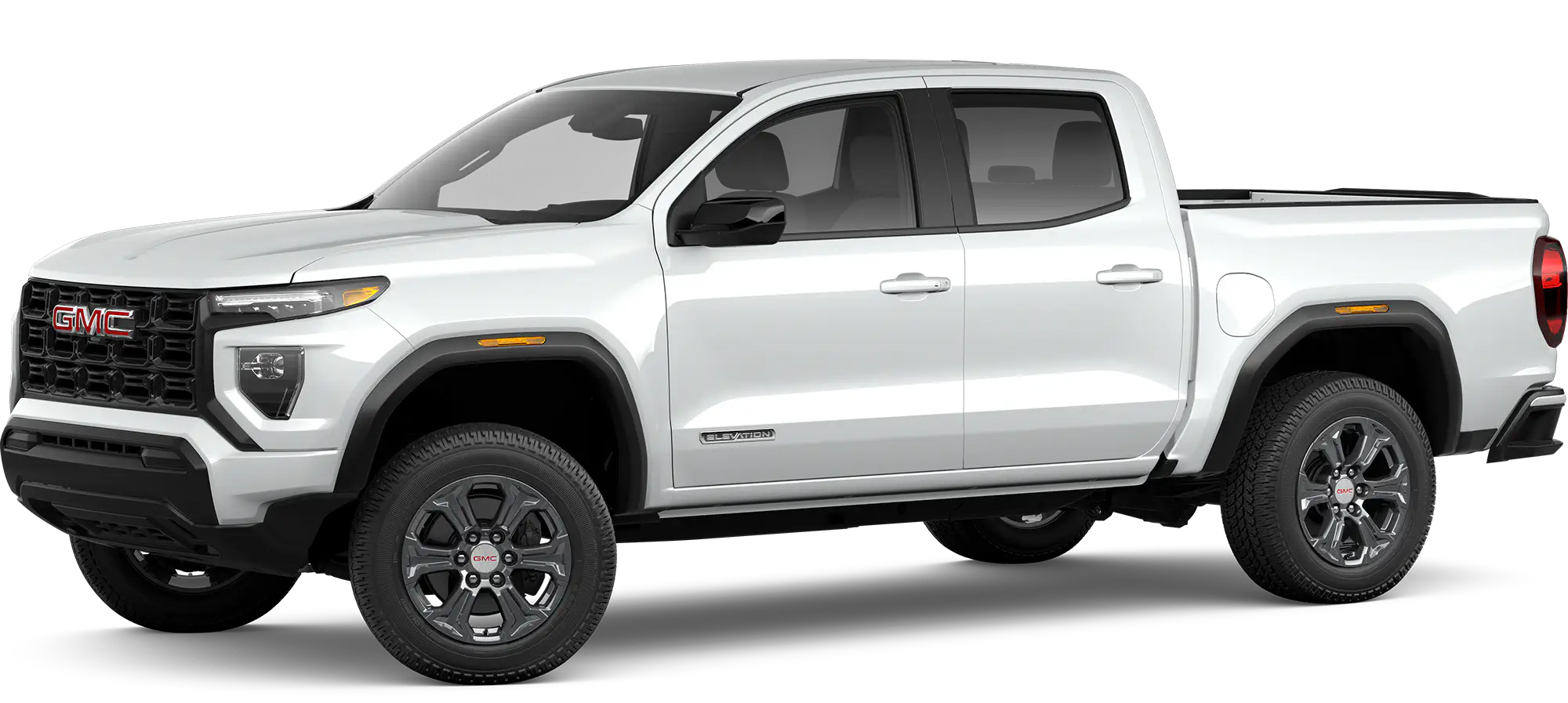
Best GMC Canyon Trim for the Money: Elevation vs AT4
Shopping for a midsize pickup often comes down to deciding how much capability you actually need.
In the GMC Canyon Elevation vs AT4 comparison, both trucks share a strong turbocharged powertrain, useful towing capacity, modern technology, and a surprisingly capable chassis, but they target slightly different buyers.
Elevation is the value-focused choice for drivers who spend most of their time commuting, towing, hauling, and tackling occasional dirt roads. AT4 adds meaningful four-wheel-drive hardware and trail-focused equipment for buyers who regularly encounter snow, mud, rocky access roads, campsites, and more demanding terrain.
For many buyers, the decision comes down to whether AT4’s additional off-road equipment is worth paying for upfront and maintaining over the long term.
Current Canyon models have made the Elevation much more capable than the term “entry-level” might suggest. GMC lists the 2026 Canyon Elevation with a 310-horsepower TurboMax engine producing 430 lb-ft of torque, an 11.3-inch center touchscreen, an 11-inch digital Driver Information Center, all-terrain tires, and an off-road suspension.
That makes Elevation an unusually complete starting point. Buyers do not have to move into AT4 simply to get the stronger engine or modern cabin technology.
AT4 builds on the Canyon platform with equipment aimed at drivers who will actually use four-wheel drive away from pavement. GMC lists AT4 with standard 4WD, a two-speed Autotrac transfer case, automatic locking rear differential, transfer-case shield, Advanced Hill Descent Control, and multiple selectable drive modes.
For everyday driving, those additions may be unnecessary. For someone regularly traveling through deep snow, loose surfaces, steep trails, or rugged rural roads, they can be worth the additional expense.
| Feature | Canyon Elevation | Canyon AT4 |
|---|---|---|
| Engine | TurboMax | TurboMax |
| Horsepower | 310 hp | 310 hp |
| Torque | 430 lb-ft | 430 lb-ft |
| Transmission | 8-speed automatic | 8-speed automatic |
| 4WD | Available | Standard |
| Two-Speed Transfer Case | Depends on configuration | Standard |
| Automatic Locking Rear Differential | Configuration dependent | Standard |
| All-Terrain Tires | Standard | Standard |
| Off-Road Focus | Moderate | Higher |
| Best For | Daily driving and general truck use | Frequent off-road and poor-road use |
Exact equipment can vary by model year, package, and configuration, so shoppers should always verify the window sticker before purchasing.
One of the most important points in the GMC Canyon Elevation vs AT4 debate is that moving to AT4 does not buy you a more powerful engine.
Both current trims use GMC’s TurboMax engine. GMC rates it at 310 horsepower and 430 lb-ft of torque, paired with an eight-speed automatic transmission.
That means straight-line acceleration and basic towing performance are not the primary reasons to upgrade.
AT4 earns its premium through drivetrain and off-road hardware.
Its standard two-speed transfer case provides greater flexibility when traction deteriorates, while the automatic locking rear differential can help keep the truck moving when one rear wheel loses traction. A transfer-case shield also provides additional protection when rocks, ruts, and uneven terrain become part of the trip.
AT4 also has 9.6 inches of ground clearance, according to GMC. Its approach angle is listed at 33.5 degrees, helping the truck negotiate obstacles without putting the front end into the terrain.
Drivers who rarely leave pavement may never exploit those advantages. Someone who frequently hunts, camps, drives forest roads, works on rural property, or deals with difficult winter conditions has a much stronger case for AT4.
Towing is another area where paying more for AT4 does not necessarily produce a major advantage.
GMC lists a maximum towing capacity of up to 7,700 pounds for both the four-wheel-drive Elevation and AT4 when properly equipped.
Payload tells a slightly different story. GMC lists maximum payload at up to 1,670 pounds for a two-wheel-drive Elevation, 1,610 pounds for an Elevation 4WD, and 1,570 pounds for AT4. Actual capacities depend on the individual truck’s configuration and equipment.
| Capability | Elevation 2WD | Elevation 4WD | AT4 |
|---|---|---|---|
| Maximum Towing | Configuration dependent | Up to 7,700 lbs | Up to 7,700 lbs |
| Maximum Payload | Up to 1,670 lbs | Up to 1,610 lbs | Up to 1,570 lbs |
| Best Use | Road-focused hauling | Mixed-use towing | Towing plus off-road travel |
Buyers primarily interested in pulling a travel trailer, utility trailer, boat, or recreational equipment therefore should not automatically assume AT4 is the better tow vehicle.
Elevation can deliver essentially the same maximum towing rating while costing less.
AT4 makes more sense when the road leading to the trailer, campsite, boat ramp, or jobsite is part of the challenge.
Pricing is where the value calculation becomes particularly important.
GMC currently lists the 2026 Elevation starting below AT4, although published figures can vary depending on whether destination charges, drivetrain selection, and configuration are included. GMC’s consumer trim pages list Elevation starting at $38,900 and AT4 starting at $45,500, illustrating a substantial base-price gap before options.
Buyers should compare actual dealer window stickers rather than relying solely on advertised starting prices.
The ownership-cost difference extends beyond MSRP.
All-terrain tires can cost more to replace than basic highway-oriented tires, and trucks that are genuinely driven off-road may experience accelerated wear to tires, alignment components, suspension parts, skid plates, wheel bearings, and underbody components.
Diagnosis for a modern truck can also become expensive when electronic systems are involved. A basic diagnostic appointment may cost roughly $100 to $250 depending on labor rates and the amount of troubleshooting required. More involved electrical, drivetrain, suspension, or 4WD problems can require additional diagnostic time before repairs even begin.
Major repairs can quickly move into four-figure territory. Transfer-case, differential, turbocharger, transmission, electronic-module, and infotainment repairs vary substantially by failure, model year, labor rate, and parts required.
Those potential expenses matter more for owners planning to keep a Canyon well beyond its original warranty period.
Routine maintenance matters regardless of which Canyon you buy. GMC recommends following the vehicle-specific maintenance schedule for inspections, fluid services, and other routine maintenance, with the owner’s manual providing the requirements for a particular vehicle.
Oil changes are especially important with a turbocharged engine. Following the oil-life monitoring system and using the correct oil specification can help protect turbocharger and engine components.
Owners should also inspect tires regularly. All-terrain tires can develop uneven wear if pressures, alignment, or rotations are neglected.
AT4 owners who regularly use their trucks off-road should pay additional attention to the underside of the vehicle. Mud, gravel, snow, road salt, and impacts can affect shields, suspension components, connectors, and drivetrain hardware.
Four-wheel-drive systems also deserve regular use and inspection. Drivers should understand how the selectable modes and transfer case operate before they actually need them on a snowy road or remote trail.
After significant off-road trips, checking for damaged tires, loose underbody protection, fluid leaks, packed mud, and unusual suspension noises is a worthwhile habit.
A Technical Service Bulletin, commonly called a TSB, is information issued by an automaker to help technicians diagnose or repair known vehicle conditions. A TSB is not automatically the same thing as a safety recall, and its existence does not necessarily mean a repair will be performed free of charge.
Canyon owners can search manufacturer communications through the NHTSA vehicle database. NHTSA allows consumers to search by year, make, and model for manufacturer communications along with recalls, investigations, and complaints.
Checking these resources before buying a used Canyon can provide useful context about known service concerns without assuming every truck will experience them.
For the broadest group of buyers, Elevation is arguably the stronger value.
You get the same core TurboMax engine, substantial towing capability, a modern digital cabin, all-terrain tires, and a truck platform already designed with more ground clearance and off-pavement capability than many conventional midsize pickups.
Someone who drives to work Monday through Friday, tows occasionally, visits home-improvement stores on weekends, and travels maintained gravel roads probably does not need AT4.
AT4 becomes much easier to justify when poor terrain is a regular part of ownership.
Drivers who frequently encounter mountain roads, deep snow, muddy job sites, hunting property, forest roads, or rocky trails can benefit from the AT4’s standard 4WD equipment, two-speed transfer case, locking rear differential, Hill Descent Control, and additional underbody protection.
There is also a middle ground worth considering: Elevation 4WD.
For buyers who want additional winter and loose-surface traction without paying for every AT4 feature, a properly configured Elevation 4WD can be one of the most compelling Canyon combinations.
Modern midsize trucks combine turbocharging, electronic drivetrain controls, touchscreen infotainment, driver-assistance equipment, cameras, sensors, and sophisticated four-wheel-drive systems. That technology improves capability and everyday usability, but it also creates more potentially expensive components as the truck ages.
AT4 adds another consideration because owners are more likely to expose the vehicle to difficult conditions. Off-road use does not guarantee problems, but repeated impacts, dirt, water, heavy loads, and difficult terrain can increase wear.
Before purchasing either trim, think about how long you plan to own it.
A driver trading every three years has a different repair-risk profile from someone planning to keep a Canyon for eight or ten years. Long-term owners should budget not only for scheduled maintenance but also for unexpected mechanical and electronic repairs once original coverage expires.
Extended coverage may be worth evaluating in that situation. Buyers can review options and eligibility through Granger Warranty before deciding whether longer-term protection fits their ownership plans.
Granger Warranty’s published plan information includes coverage options for major systems and high-tech components, depending on the selected plan. Coverage terms, exclusions, eligibility, and deductibles should always be reviewed before purchase.
AT4 can be worth the premium for drivers who regularly use four-wheel drive or travel on difficult terrain. Its standard two-speed transfer case, automatic locking rear differential, Hill Descent Control, and transfer-case protection provide functional upgrades rather than cosmetic changes.
For mostly paved-road driving, Elevation generally offers better value because it retains the same core engine and strong towing capability.
No. Current Elevation and AT4 models both use the TurboMax engine rated at 310 horsepower and 430 lb-ft of torque.
Choosing AT4 is primarily about traction, drivetrain hardware, and off-road capability rather than additional engine output.
Elevation 4WD and AT4 can both tow up to 7,700 pounds when properly equipped.
Elevation may be the better value for conventional highway towing, while AT4 can be useful if towing regularly involves unimproved roads, slippery boat ramps, campsites, or difficult terrain.
A Canyon Elevation equipped with 4WD can be a strong winter vehicle, especially when fitted with tires appropriate for the conditions. Four-wheel drive helps the truck accelerate on slippery surfaces, but braking and cornering still depend heavily on tire traction.
AT4 adds hardware that becomes more valuable when winter driving extends beyond routinely plowed streets into deeper snow or poorly maintained roads.
Elevation may have the value advantage for owners who want Canyon capability without paying for off-road equipment they rarely use. AT4 makes more sense for owners who will regularly benefit from its additional drivetrain and trail hardware.
For either truck, long-term ownership means considering the potential cost of turbocharged powertrain components, electronics, infotainment systems, suspension hardware, and drivetrain repairs after original warranty coverage expires.
Choosing between GMC Canyon Elevation vs AT4 should start with how you actually plan to use the truck. Elevation is difficult to beat for daily driving, towing, and general-purpose ownership, while AT4 earns its higher price when four-wheel-drive capability and tougher terrain are routine parts of the job.
Drivers planning to keep either Canyon beyond its original warranty period can also compare extended coverage before repair risk begins to increase. Granger Warranty offers online plan information and pricing, with options that can cover major mechanical and high-tech components depending on the contract selected.
Review the coverage details, exclusions, eligibility requirements, and ownership timeline, then compare the cost of protection with the repair exposure you’re comfortable carrying yourself. Visit Granger Warranty to explore available options for your GMC Canyon.
Stay up to date with the latest news from Granger Warranty